Search for generative engine optimization tools and you will find a dozen listicles, most of them published by a vendor that ranks itself first. This one is published by a vendor too. Hoverify is our product, its GEO checker appears below, and you should read the rest with that in mind. What I can offer instead of neutrality is verification: every price and tier here was checked on the vendor’s own site on 1 September 2026, and where a vendor does not publish a price, this post says so rather than repeating a number from somewhere else.
The more useful thing most of those lists skip is that “GEO tool” names two products that do entirely different jobs.
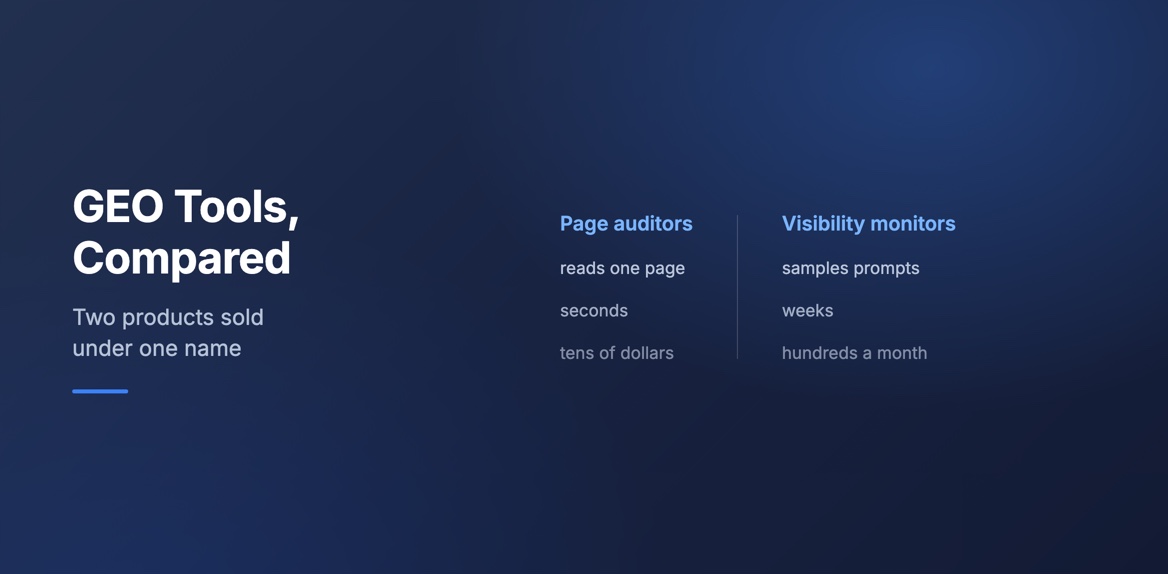
Two kinds of generative engine optimization tools
One kind looks at a page and tells you whether a machine can read it. It scores structure, markup, server rendering and crawler files, and the output is a list of things to fix. It costs tens of dollars, runs in seconds and cares nothing about your brand.
The other kind runs prompts against ChatGPT, Perplexity and friends on a schedule, then reports how often you got mentioned and how you were described. It costs hundreds of dollars a month, reports over weeks and cannot tell you why you were left out.
Buying the second when you needed the first is the common and expensive mistake. A monitoring subscription will faithfully report that nobody cites you, for a year, while the reason sits in your HTML. As the research on GEO shows, the citation half of this problem assumes you were retrieved in the first place, and retrieval is what the cheap tools measure.
Page-level GEO tools that audit and fix
These answer the question “can a machine read this page, and what is wrong with it?”
Hoverify GEO checker
Ours, so treat the description as a spec sheet rather than a review. It scores 16 weighted categories from a panel on the page you already have open, which means it works on staging, on localhost and behind a login, where anything URL-based cannot go. The 0 to 100 score is the weighted average of the 10 technical categories. Failed checks link into the tools that fix them, which is the part I would actually defend as a difference: a schema failure opens the schema templates, an alt-text failure opens the accessibility tool. It comes with the extension at $30 a year or $89 once, with no free tier and a 14-day refund instead of a trial.
Glippy
The closest thing to a direct competitor and a good product. A Chrome extension with an MCP server, also 16 categories, advertising 240 or more checks. Free for 11 full scans, then a one-time Pro licence listed at 50% off, at 19.99 euro or 24.99 dollars against a regular 39.99 euro or 49.99 dollar price, covering 3 devices for life. If you want one focused tool and nothing else, this is the honest recommendation, and its free tier means you can settle the question yourself before paying anybody.
Ora
A free web scan at ora.ai plus a command line version through npx ax audit. It leans further toward agents than crawlers, auditing WebMCP tooling and calling its result an agent experience ranking rather than a GEO score. Its homepage claimed more than 60,000 sites scanned at an average rank of 42. We ran our own engine against it in August and reached broadly the same verdict on their site that they did, which is reassuring about both rubrics. Free, no sign-up, so there is no reason not to run it.
Lighthouse agentic browsing
Already in Chrome, free and worth knowing about before you buy anything. Google’s own documentation is careful here: the category needs Chrome 150 or later, it and WebMCP support are described as experimental, the WebMCP audits require joining an origin trial, and it reports a fraction of checks passed rather than a score out of 100. It checks the accessibility tree, layout stability and whether you have an llms.txt with an H1, some length and some links in it. Several blog posts claim it runs by default from Lighthouse 13.3; Google’s documentation does not say that, so believe the documentation.
The irony is worth pausing on. Google Search says llms.txt does nothing for rankings, and Google Chrome ships an audit that checks for one. Both are true, because they are different teams answering different questions, and it is a good illustration of why “Google says” is rarely a complete sentence.
AI visibility monitors and answer engine optimization tools
These answer a different question: “when somebody asks about my category, am I mentioned?”
| Tool | Price checked 1 Sep 2026 | Prompts | Engines |
|---|---|---|---|
| Otterly.AI | $29, $189 or $489 a month; enterprise from $1,000 | 15, 100 or 400 | 4 included; Claude, AI Mode and Gemini cost extra |
| Profound | $99 or $399 a month billed yearly; enterprise on request | 50 or 100 a month | 1 on Starter, 3 on Growth |
| Peec AI | Not published on their pricing page | Varies by tier | 6 named, count varies by tier |
| Semrush | $117 to $456 a month billed annually | 50 to 200 daily | Included in paid tiers |
Four observations from putting that table together.
The prompt allowances are the real unit of pricing, and they are small. Profound’s $99 tier buys 50 prompts a month against one engine. If your category has 30 ways of being asked about, you are sampling, not monitoring.
Peec AI does not publish prices. Their pricing page lists 4 tiers and no numbers. Several roundups quote a figure anyway; I could not verify one, so this post does not carry one.
The suites have absorbed the feature, but not in the same way, so check before you buy. Semrush includes AI tracking in its paid plans. Ahrefs splits it: paid plans carry 5 to 20 custom prompts depending on tier, and anything beyond that is Brand Radar, from $50 a month, with a fuller AI Visibility Index at $199. If you already pay for one of these, find out what you own before buying a second subscription.
And the results are unstable by nature. These tools sample a stochastic system: ask the same question twice and the sources change. Read the trend over months and ignore any single reading, whatever the dashboard implies.
What the scores and check counts actually mean
Less than they appear to, and this applies to our tool as much as anyone’s.
Check counts are not comparable. A tool advertising 240 checks and one advertising 80 may do the same work, because one counts every required property of every schema type as its own check and the other counts the schema as one. Neither is lying. There is no shared definition, so the number tells you about the marketing rather than the coverage.
Scores are not comparable either. Every tool invents its own rubric and weights. Ours weights structured data and machine readability at 1.5 times, citability at 1.3 and agent interactivity at 0.2, and those weights are our judgment about what matters, not measurements of what ranks. A 90 in one tool and a 90 in another are two different opinions that happen to share a number.
What is worth comparing is the list of failures. If two tools independently tell you your main content is missing from the server response, that is a fact about your page, and it would be a fact if neither tool existed. Use these things as issue-finders and treat the number as a progress bar for yourself.
Which one you actually need
If you have never audited a page, start free. Run Lighthouse, which you already have, and Ora, which costs nothing, and see whether they agree that something is broken. That answer is often enough to occupy a month of work, and you will have spent nothing.
If you are fixing pages regularly, buy a page-level tool. Glippy if you want one thing that does this well, ours if you want the failures to open the tools that fix them and you want it working on pages that are not public yet. Either way it is a rounding error next to a monitoring subscription.
Buy monitoring when you have a brand worth monitoring and somebody whose job is to act on it. It answers a real question and answers it reasonably well. It is the wrong first purchase, because it measures an outcome you cannot yet influence.
The order matters more than the brand. Make the page readable, then make it quotable, then find out whether anybody is quoting it. Most of the money in this category is spent on step three by people still stuck on step one.