Generative engine optimization is the practice of getting your content retrieved, quoted and cited by systems that answer questions instead of returning links: ChatGPT, Perplexity, Google’s AI Overviews and the growing pile of agents that read the web on somebody’s behalf.
That is the definition. The harder question is which parts of it are supported by evidence and which are folklore that got repeated until it sounded settled. I went through the academic work, Google’s own guidance and the 16 categories our audit tool scores, and the answer is less flattering to the field than most introductions admit. Disclosure: Hoverify is our product, and its GEO checker is one of the tools described below.
What generative engine optimization means
The term comes from a 2023 paper by Pranjal Aggarwal and five co-authors, published at KDD 2024. They built a benchmark of 10,000 queries, rewrote source pages 9 different ways and measured how often each version got used in the generated answer.
The mechanism is worth being precise about, because the whole subject makes more sense once you see it. A generative engine answers a question in stages. It decides whether to search at all. It retrieves a set of candidate documents. It ranks and trims them to fit a context window. It writes an answer from what survived, citing some sources and silently absorbing others.
You are optimizing for a pipeline, not a ranking. Your page can lose at any stage, and the reasons it loses at stage two have nothing to do with the reasons it loses at stage four.
Is answer engine optimization the same thing?
Mostly, yes. Answer engine optimization, AI search optimization, LLM SEO, GEO SEO and generative engine optimization all describe the same activity, and the differences between them are marketing rather than method. Nobody has established a distinction that survives contact with an actual task.
A warning about the abbreviation: GEO already meant geographic, so searches for “geo seo” pull in local search results, and tools calling themselves GEO platforms are sometimes selling local SEO. Read the page before you buy the tool.
What the research actually supports
Here the field gets uncomfortable, and it is better to know this before you spend a quarter on it.
The founding paper’s results are real. Rewriting a page to add quotations, statistics and citations produced the biggest gains, with the headline figure being up to 40% more visibility. Their scores on one of the two metrics, position-adjusted word count, ran like this against an unoptimized baseline of 19.5:
| Rewrite | Score | Verdict |
|---|---|---|
| Quotation addition | 27.8 | Best performer |
| Statistics addition | 25.9 | About 41% over baseline |
| Cite sources | 24.9 | About 30% over baseline |
| Unique words | 20.7 | Barely moved |
| Keyword stuffing | 17.8 | Worse than doing nothing |
Keyword stuffing scoring below the baseline is the useful result there. The reflex imported from 2010 SEO actively costs you.
Now the caveat that most articles quoting the 40% figure leave out. A critical survey published in July 2026 by Olivier Martinez read 45 studies from the preceding three years and concluded that the evidence base is much narrower than the enthusiasm. Already-retrieved content can be rewritten to change how it gets cited, which is what the founding paper measured. But no technique it reviewed showed a stable, repeatable effect on organic discoverability across platforms and over time.
Read that carefully, because it is the thing to take away. The experiments that work assume your page is already in the model’s context. They tell you how to win once you are in the room. They do not tell you how to get in.
The survey’s other findings are worth holding onto. Topical relevance and where your content sits in the context window were the most reproducible levers. Generic checklists transferred badly between settings. Gains erode as competitors do the same thing. And rewriting aggressively for citability can damage your retrieval, which means it is possible to optimize yourself out of the running.
Google’s position, updated in July 2026, is the same story in a different accent. Its AI optimization guide says to create genuinely useful content, keep the site crawlable and indexable, follow ordinary SEO practice and skip the AI-specific rituals. It states plainly that you do not need special files or markup to appear in AI features, which is the same conclusion we reached testing llms.txt against live sites.
Getting retrieved, then getting cited
Splitting the problem in two is the most useful idea in the whole subject.
Retrieval is whether a machine can find, fetch and parse your page at all: text the server ships, a site a crawler can walk, headings that describe their sections, content that exists before JavaScript runs. This half is well understood, boring and largely identical to technical SEO. It is also the half that silently disqualifies most sites.
Citation is the second stage. Once your page is in the context window, does the model quote you or the source sitting next to you? That is where the research findings live: direct answers, quotable sentences, figures with sources attached, definitions that stand alone.
The industry sells the second half. The first half is what stops most sites. A page whose text only appears after hydration cannot be cited no matter how quotable it is, and no amount of statistics-adding fixes a page a crawler never parsed.
How AI search optimization differs from SEO
Less than the term implies, but the differences are real.
There is often no click. Traditional SEO trades in positions that produce visits; an AI answer may use your work and send nobody. Being the source of a sentence is the win, and your analytics will not show it.
Extraction happens on text. A search crawler can be patient with a JavaScript-heavy page. Many AI crawlers fetch the HTML once and take what is there, so client-rendered content is simply absent.
You are competing for space inside one answer, not for a rank. Ten blue links had ten slots. An answer has room for perhaps three sources, so the distribution is harsher.
And the results are unstable. The same prompt asked twice returns different sources. The survey above found exactly this: run-to-run variability and low overlap between what different tools report. Treat any single check as a sample, not a measurement.
The 16 categories a GEO audit scores
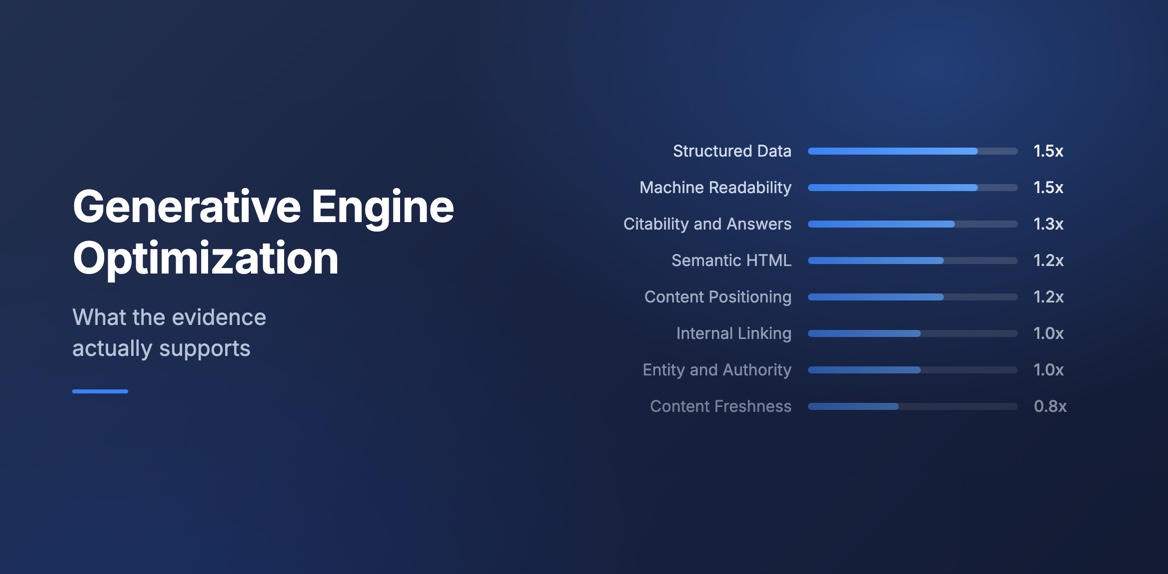
Our checker scores a page across 16 categories, weighted by how much each one appears to matter. 10 of them are technical and computed from the page and your origin; 6 are content-quality judgments. The weights are the honest part, because they say what we think is load-bearing:
| Category | Weight | What it looks at |
|---|---|---|
| Machine Readability | 1.5x | Text-to-HTML ratio, server rendering, Markdown alternates, feeds |
| Citability and Answers | 1.3x | Direct answers, quotable sentences, definitions, stats formatting |
| Semantic HTML | 1.2x | Heading hierarchy, one H1, landmarks, lists, tables |
| Content Positioning | 1.2x | Whether there is a reason to pick you over a lookalike |
| Structured Data | 1.0x | JSON-LD, types, required properties and whether it matches the visible text |
| Accessibility for Agents | 1.0x | Alt text, labels, link text, lang attribute |
| Internal Linking | 1.0x | Link structure, anchor quality, orphaned pages |
| Meta and Discoverability | 1.0x | Titles, canonicals, robots rules for AI crawlers, sitemap, llms.txt |
| Entity and Authority | 1.0x | Author and organization schema, credentials, dates |
| Information Density | 1.0x | Substance per sentence; marketing foam extracts to nothing |
| Content Freshness | 0.8x | Whether a machine can tell the page is current |
| Factual Verifiability | 0.8x | Citations, attribution, primary sources |
| Content Comprehensiveness | 0.8x | Whether the page covers its topic deeply enough |
| Multimodal Content | 0.5x | Alt quality, captions, transcripts |
| Performance and Crawlability | 0.3x | In-browser signals of crawl cost |
| Agent Interactivity | 0.2x | WebMCP, agent cards and other emerging standards |
Two things to be honest about here.
The bottom of that table is speculative. Agent interactivity is weighted 0.2x because the standards are new and nobody can show they affect anything yet. It scores as a bonus, so an absent agent card never counts against you. Any tool weighting emerging standards heavily is guessing with more confidence than the evidence supports.
The table used to disagree with Google. Google’s guidance says structured data is not required for generative AI search and there is no special schema to add. When this post first went up the checker weighted Structured Data 1.5x anyway, the joint heaviest category, on the argument that schema resolves entities for every consumer rather than Google alone, and the post defended that as a deliberate judgment call. On 7 September 2026 the checker cut it to 1.0x after an evidence review. Google and Bing both say markup helps their systems understand and verify a page, neither says it lifts AI citations, and the one controlled study found no effect on citations at all. So the weight came down to the ordinary 1.0x, a page with no JSON-LD now gets a warning rather than a failure, and the help text on that row says plainly that markup is not required for AI answers. It keeps a full weight rather than dropping further because schema still earns rich results in ordinary search, still resolves entities and still feeds the product graph that AI shopping answers draw on. That is still a judgment call, and a revised one.
What to do first
Ordered by evidence, which puts it almost backwards from how the subject is usually taught.
- Make your content server-rendered. If the text is not in the HTML response, nothing else on this list matters.
- Fix headings and structure so a parser can tell what answers what.
- Answer questions directly, near the top, in sentences that survive being lifted out of the page.
- Attach sources and figures to claims. This is the best-supported content finding in the literature.
- Say who wrote it and when, in markup as well as prose.
- Then, if you like, the emerging-standard files. They cost an afternoon and currently do nothing measurable.
Steps 1 and 2 are the ones people skip because they are unglamorous, and they are the ones that decide whether the rest gets read. The GEO checker runs all 16 categories from a panel on the page you are already looking at, including a page you have not published yet, which is the point at which fixing any of this is cheap.
One closing caution, in the spirit of the survey. Anyone selling certainty about AI search is ahead of the evidence. The retrieval half is ordinary craft that has paid off for twenty years and will keep paying. The citation half has real findings behind it and real limits on them. Everything past that is a bet, and it is worth knowing which parts of your strategy are bets.